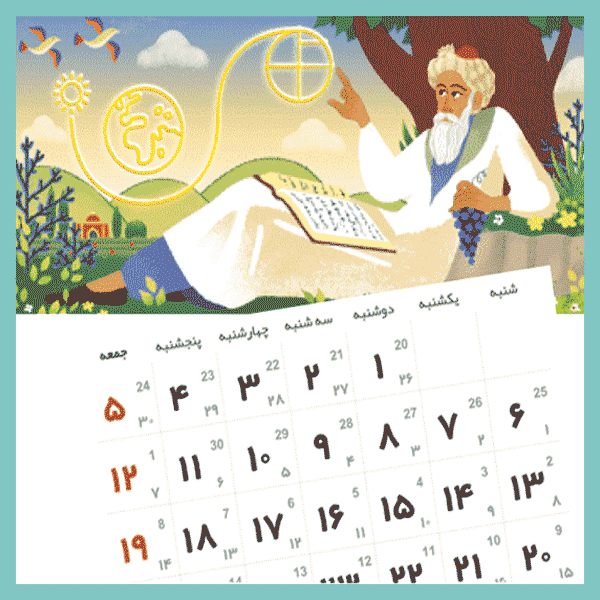
Solar Hijri calendar (taqvim-e hejri-ye šamsi), based on Jalâli Calendar (aka Persian calendar), is used in Iran and Afghanistan, but names of the months are different in Farsi and Dari. In this section, you can learn both Dari and Farsi names of the months.
For the majority of non-Persian speakers, it is difficult to learn all these new names, especially when they figure out that the beginning day of each month in Jalâli calendar is not the 1st day in Georgian calendar but it is the 20th or 21st of each month in the aforementioned calendar. Maybe knowing some interesting facts about this calendar motivates you to try learning it.
- This calendar has 365 days (366 days in a leap year). Each New Year starts on 20 or 21 of March. However, New Years never start at midnight in this calendar. In fact, the solar year begins at the instant nearest to the vernal equinox as determined by astronomical calculations for the Iran Standard Time meridian. This instant has been determined most precisely since long by Iranian scholars including the 11 century polymath “Xayyâm”. The origin of the calendar that is now used in Iran and Afghanistan is the year that Mohammad the Prophet emigrated from Mecca to Medina.
- In this calendar, having said that the first six months of the year have 31 days, the next 5 months have 30 days while the last one has 29 days. In a leap year, that occurs every four years, the extra day is added to the last month of the mentioned year, “esfand”. So it is important that in a leap year, your Iranian and Afghan friends’ birthday is one day before what you usually celebrate.
- Not confusing enough so far? O.K., let’s learn a little bit about the weekends and bank holidays. In Iran, each week starts on Saturday, “šanbe(h)” in Farsi. If you know numbers, it is very easy to learn weekdays. Just add numbers as prefix to “šanbe(h)” for the other weekdays, except for the last one that is called “jom’e(h)” or “âdine(h)”. Iranian weekends are Thursday and Friday. In Iran, there are two types of bank holidays; religious holidays (17 days) and national holidays (10 days). Because the religious holidays are according to lunar calendar which is 11 days shorter than the solar one, these holidays are changing every year. However, the other holidays such as Nouruz (New Year), anniversary of revolution and Iran’s national day are fixed in this calendar.